How to Pass the RES Exam: Study Tips and Time Management
Published 8 Oct 2026
Many people who take the RES exam do not pass on the first try. The good news is that most of them fail for the same few reasons, and you can plan around every one of them. This guide covers how to pass the RES exam: what the passing mark really means, how to study, and how to manage your time on the day. Exam details are taken from CEA and NTUC LearningHub and were checked in October 2026.
If you are not yet sure how the course and exam work, start with our guide to the RES course and RES exam.
Is the RES exam difficult?
It is not difficult in the way a maths exam is difficult. Nothing needs to be worked out from first principles. It is difficult because of how much there is to remember and how precisely you need to remember it.
Three things catch people out:
- The syllabus is wide. Land law, contracts, HDB rules, planning, taxes, financing, money laundering checks and the rules on how agents must behave are all in it. Most of it is new to most candidates.
- The questions test fine details. Knowing that there is a stamp duty is not enough. You need to know who pays it, when, and at what rate.
- Many options look right. The wrong options are written to be close to the right one. If your understanding is roughly right, you will often pick the roughly right answer, which is wrong.
So the RES exam rewards exact knowledge and practice, not intelligence alone. That is good news, because both can be trained.
RES exam passing mark and passing rate
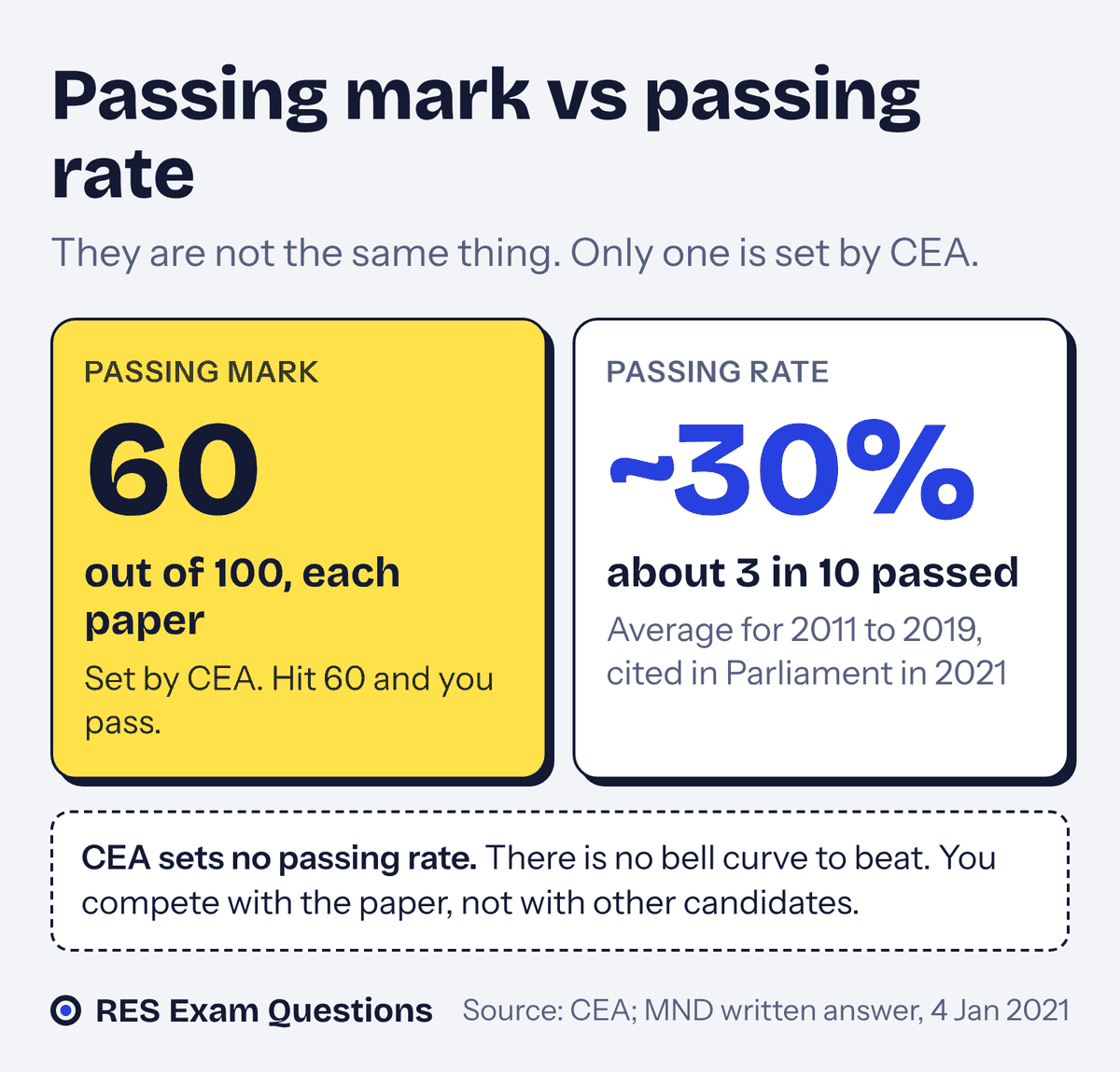
The passing mark is 60 for each paper. Each paper is out of 100, and you must pass both. CEA states this on its website and says the mark is subject to review.
The passing rate is a different thing. In January 2021, a Member of Parliament asked about an average annual passing rate of 30% for the RES exam from 2011 to 2019. In its written answer, the Ministry of National Development said that CEA sets the passing mark at 60 but does not set a passing rate.
Two things follow from this:
- You are not competing with other candidates. There is no fixed share of people who must fail. If you score 60, you pass, however well everyone else does.
- Roughly 3 in 10 passing is a warning, not a verdict. It tells you that many people go in under-prepared. It does not tell you your own chances. Those depend on how you prepare.
How to study for the RES exam
Know how you learn before you plan
Some people can sit for three hours and absorb everything. Others lose focus after forty minutes. Be honest about which one you are, and plan your study around it, not around what a friend did.
If you focus better in short bursts, do two 45-minute sessions a day instead of one long one on weekends. If you need someone to explain things to you, do not rely on reading the notes alone. Ask your trainer, or study with one or two classmates.
Study topic by topic, not cover to cover
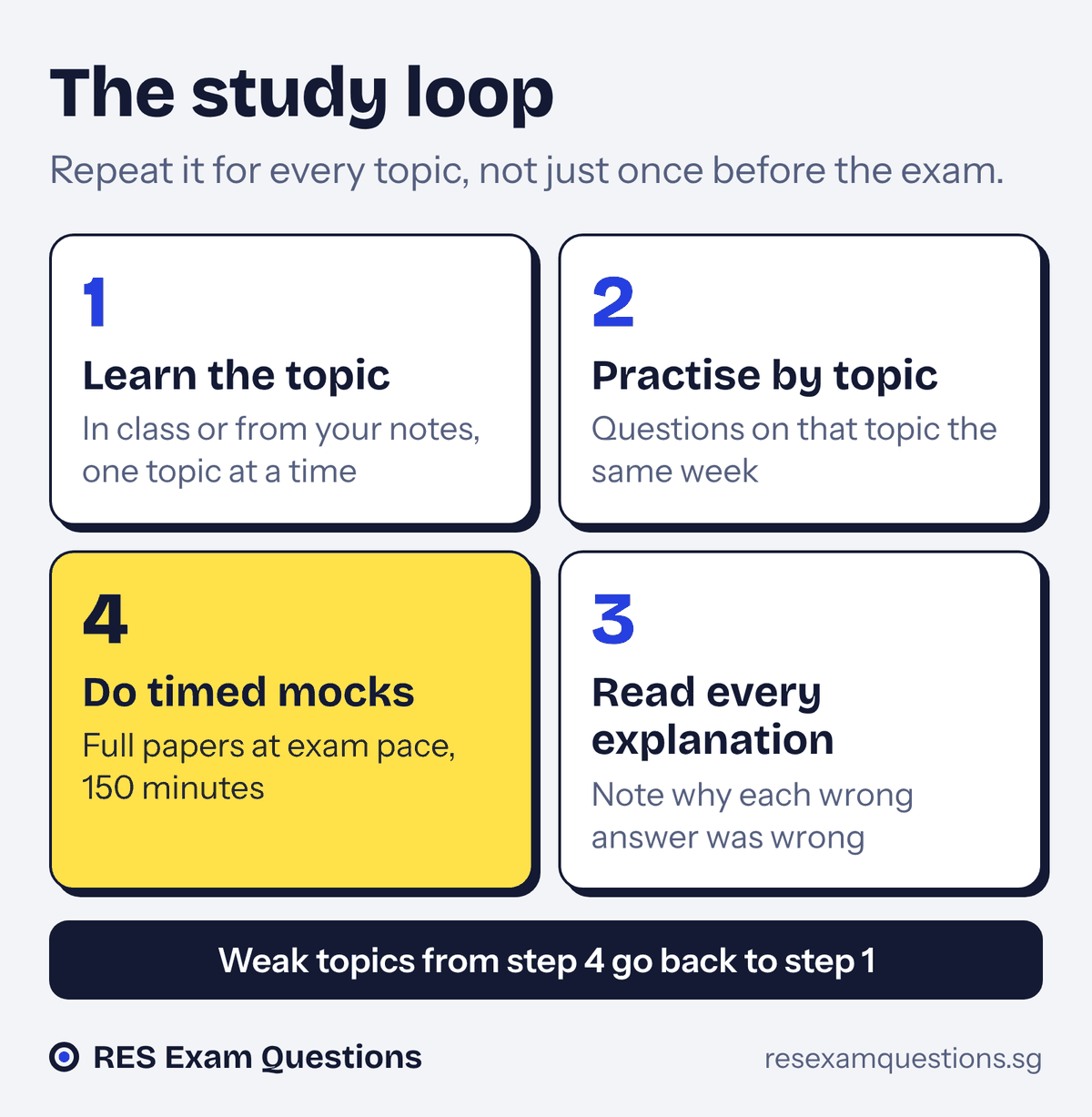
The syllabus is split into topics for a reason. Finish one topic properly before moving on. Reading the whole book once and hoping it sticks is the most common plan, and it is the one that fails most often.
Practise questions while the course is still running
Do not wait until the course ends to start on practice questions. After each lesson, do questions on that topic within the same week, while it is still fresh. This shows you quickly what you only thought you understood.
Read the explanation for every question, including the ones you got right
A correct answer can be a lucky guess. Reading the explanation confirms you got it right for the right reason. For wrong answers, find out why your option was wrong, not just which one was right. That is where the marks come from.
Keep a list of what you got wrong
Write down every rule you got wrong, in one line each. For example: "Option fee for HDB resale is capped at $1,000." Read the list once a week. In the last two weeks before the exam, this list is worth more than your whole textbook.
Start full mock papers early
Do your first full timed paper at least four weeks before the exam, not the week before. Your first mock score will probably disappoint you. That is the point: you still have time to fix it.
How to manage your time in the RES exam
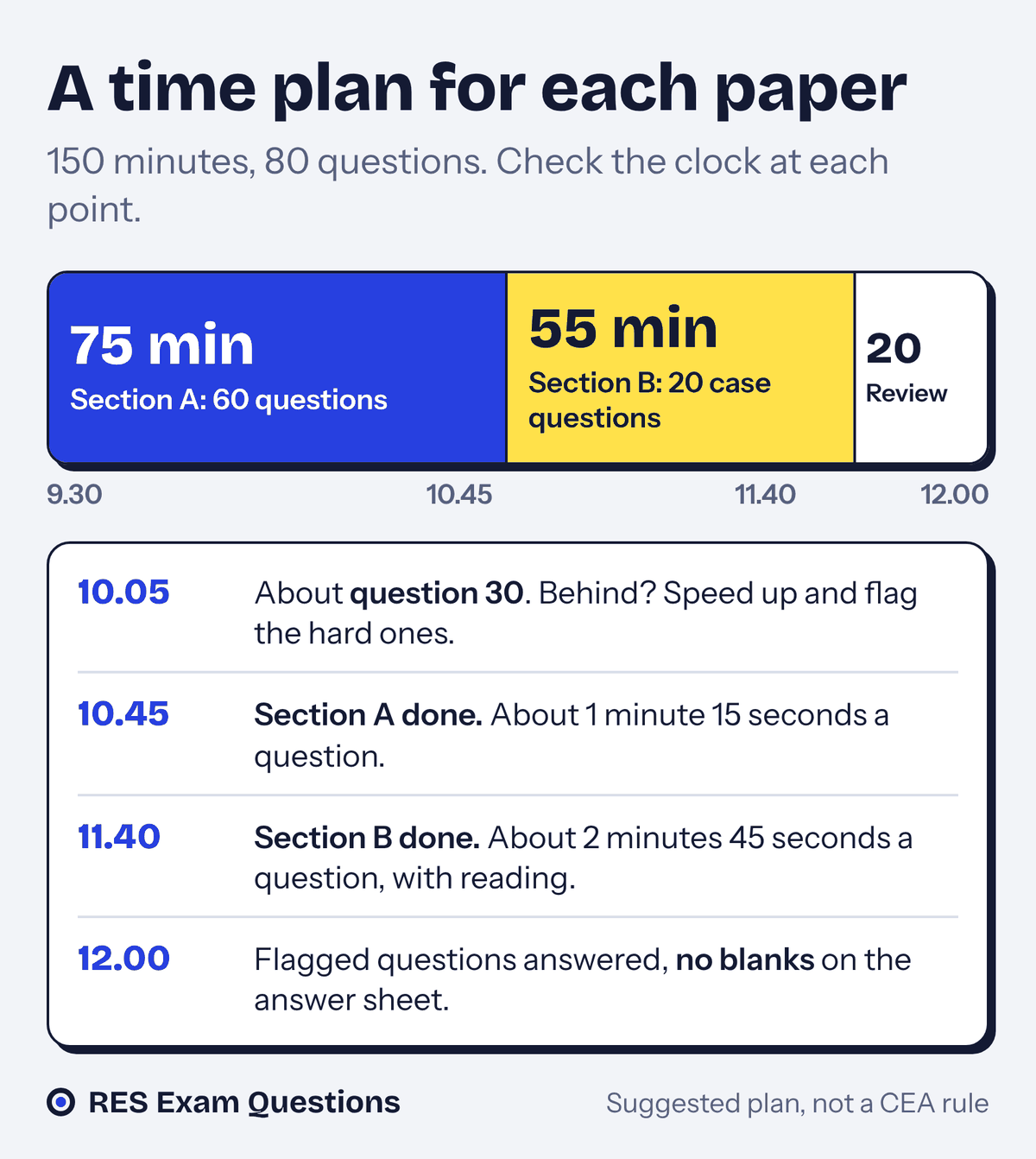
How long is the RES exam? Each paper is 2.5 hours, or 150 minutes. In that time you answer 80 questions:
- Section A: 60 multiple-choice questions, worth 60 marks
- Section B: 20 multiple-choice questions on one or two case studies, worth 40 marks
That is just under 2 minutes a question on average. But the two sections are not equal. Each Section B question is worth 2 marks and needs time to read the case. Plan your time by section, not by question.
A simple time plan
For a paper that starts at 9.30am:
- 9.30 to 10.45 (75 minutes): Section A. About 1 minute 15 seconds a question. At 10.05 you should be at about question 30.
- 10.45 to 11.40 (55 minutes): Section B. About 2 minutes 45 seconds a question, including reading the case.
- 11.40 to 12.00 (20 minutes): review. Go back to the questions you flagged, and check that every answer is on the answer sheet.
This is our suggested plan, not a CEA rule. Adjust it once you know your own pace from mock papers.
Rules that save you time
- Do not get stuck. If a question is still unclear after a minute and a half, pick your best answer, flag it and move on. One hard question should never cost you three easy ones.
- Never leave a blank. A blank earns nothing. A best guess between two options is a 50% chance.
- Fill in the answer sheet as you go. Do not plan to transfer all your answers in the last ten minutes. That is how people run out of time with answers still in the question booklet.
- Watch for "NOT" and "EXCEPT". Questions that ask which statement is not correct are the easiest to get wrong when you are rushing. Circle the word when you see it.
How to pass RES Paper 2 and the case studies
Section B carries 40 of the 100 marks in each paper, so it can make or break your result. Paper 2 case studies usually follow a transaction, such as a sale, a resale flat or a tenancy, so you need to know the steps and forms in order.
A method that works for most people:
- Read the questions before the case. Skim the questions first so you know what to look for.
- Then read the case and mark the facts. Underline dates, prices, who is buying and selling, the type of property, and anything about citizenship or existing properties. Questions usually turn on these details.
- Answer from the case, not from your own assumptions. If the case does not say something, do not add it.
- Watch the dates. Many case questions are really timing questions: when an option expires, when a payment is due, when a period ends.
The best way to get better at case studies is to do them under time. Practise reading a full case and answering its questions in about 25 to 30 minutes.
The last two weeks before the exam
- Weeks 2 and 1 before the exam: do at least two full timed papers each week, and go through your list of wrong answers after each one.
- The last few days: stop learning new material. Revise your weak topics and your list.
- The day before: pack your things and sleep early. A tired mind misreads questions.
What to bring for the RES exam
According to NTUC LearningHub's exam rules:
- Physical identification: your NRIC, passport, driving licence or Employment Pass. Digital ID is not accepted.
- A 2B pencil and an eraser.
- A calculator, if you need one. It must not be programmable, and it must have no wireless or text-editing functions. Phone calculators are not allowed.
Aim to arrive early. If you arrive 15 minutes or more after the exam starts, you will not be allowed to sit, and the fee is not refunded. You also cannot leave during the first hour or the last 15 minutes. Check the latest rules from NTUC LearningHub before your sitting, as they can change.
Frequently asked questions
How many questions are there in the RES exam?
Each paper has 80 multiple-choice questions: 60 in Section A and 20 case study questions in Section B. Across both papers, that is 160 questions.
How many marks do I need to pass the RES exam?
You need at least 60 out of 100 in each paper. You must pass both papers.
What is the RES exam passing rate?
CEA does not set or publish a fixed passing rate. In Parliament in 2021, the average annual passing rate from 2011 to 2019 was cited as 30%.
Is the RES exam open book?
No. Notes, documents and phones must be kept in your bag in a designated area during the exam.
Can I retake only the paper I failed?
Yes. If you have passed one paper, you can take a modular sitting for the other paper only, as long as your course certificate is still valid.
How long should I study for the RES exam?
It depends on your background and how you learn. Most people need several weeks of steady revision on top of the course. Start practising during the course, and do your first full mock at least four weeks before the exam.
Start practising
Knowing the rules is half the work. The other half is practising until you can pick the right option quickly and under time pressure.
Try our free 10-question RES sample test to see where you stand. Members get 1,400 RES exam questions written for the 2027 syllabus, with an explanation for every answer and timed mock papers that follow the real exam timing. More guides are on our RES exam guides page.