RES Course and RES Exam Singapore 2026/2027: Providers, Requirements, Fees and How to Register
Published 8 Oct 2026
If you want to be a property agent in Singapore, you have to clear two things first: the RES course and the RES exam. This guide walks you through both, from the entry requirements and course providers to SkillsFuture, exam registration, fees and what happens after you pass. Figures are taken from the Council for Estate Agencies (CEA) and were checked in October 2026.
What is the RES course and RES exam?
RES stands for Real Estate Salesperson. That is the official name for a property agent in Singapore. Every agent must be registered with CEA through a licensed estate agency such as PropNex, ERA, Huttons or OrangeTee.
To get there, the path is the same for everyone:
- Meet the entry requirements.
- Complete the RES course with a CEA Approved Course Provider.
- Pass both papers of the RES exam.
- Join a licensed estate agency, which applies to CEA for your registration.
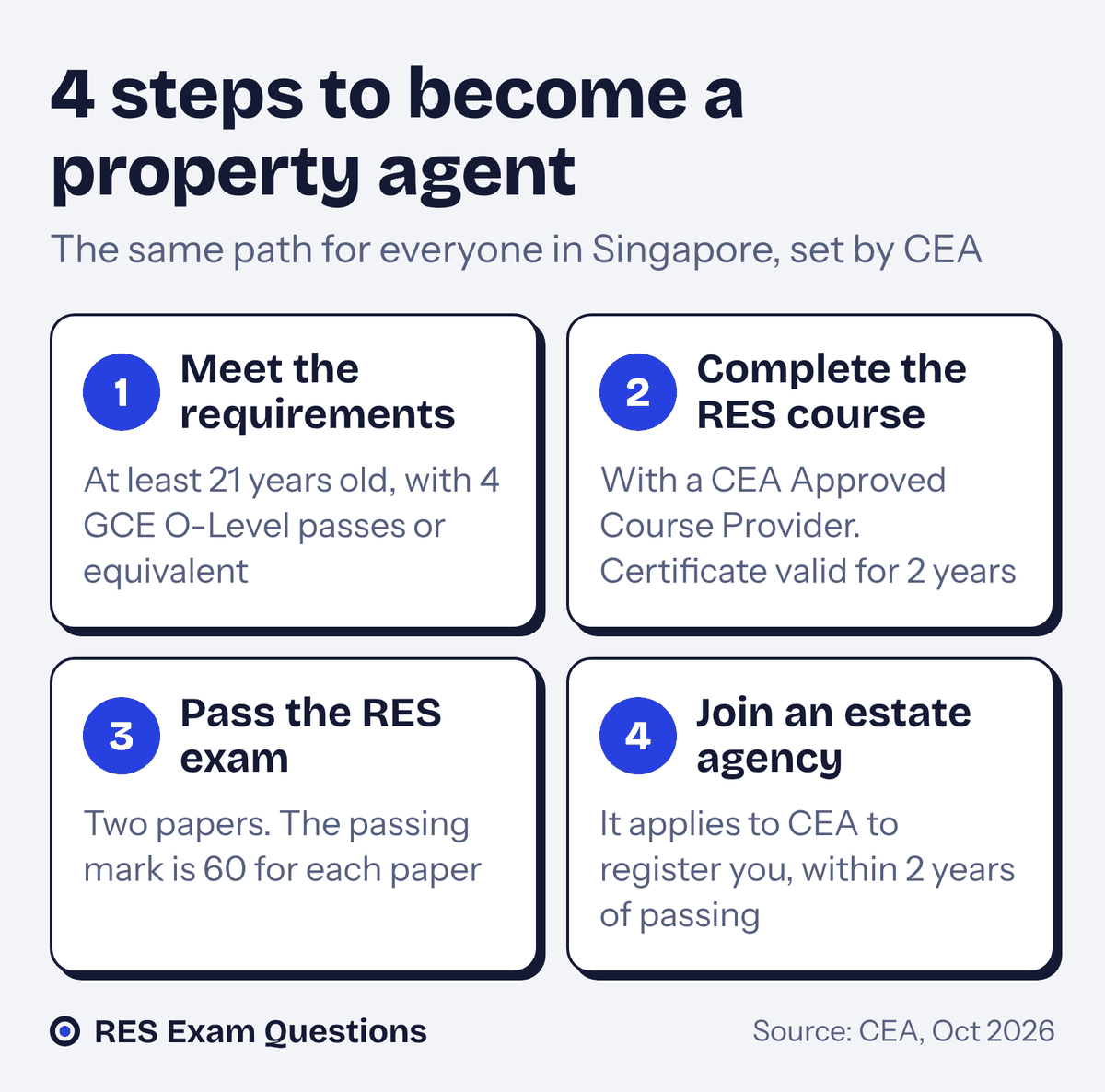
You cannot skip the course and go straight to the exam. The course certificate is your ticket to register for the exam.
RES course requirements: who can sign up
Before paying for a course, check that you qualify. CEA's requirements are:
- Education: at least four GCE O-Level passes or equivalent. The passes can be combined from not more than two sittings. If you do not have this, you can qualify with Level 5 and above in all five components of the Workplace Literacy and Numeracy (WPLN) assessment.
- Age: you must be at least 21 years old to be registered as a salesperson.
- Fit and proper: you cannot be registered if you are an undischarged bankrupt, or have a conviction involving dishonesty or fraud, among other criteria.
- No moneylending: you cannot hold a moneylender's licence.
If your qualifications are from overseas, CEA has an Educational Qualification Assessment form. Sort this out before you enrol, not after.
Singapore Permanent Residents can register as agents too. Those with less than 10 years of residency need to provide a Certificate of No Criminal Conviction or similar proof.
RES course providers in Singapore
Only courses run by CEA Approved Course Providers count. As listed by CEA, they are:
- Benchmark Realpro
- Hastor Property Services
- Life Mastery Academy (LMA)
- Ngee Ann Polytechnic
- Pioneer Training & Consultancy
- Real Centre Network (RCN)
- Realty International Associates (RIA)
- Singapore Institute of Estate Agents (SIEA)
Always check the latest list on the CEA website before you pay, because the list can change.
All providers teach the same CEA syllabus. What differs is the trainer, the class timing, the mode (classroom, online or a mix), the notes and the price.
Pick a class pace that suits how you learn
This is the part most people skip, and it is one of the main reasons people struggle later.
The syllabus is heavy. It covers land law, planning rules, HDB and private property procedures, taxes, financing and the rules that govern agents. Most of it will be new to you.
So before you choose a provider, be honest about your own learning habits:
- Can you sit through long hours? Some classes run full days. Ngee Ann Polytechnic's weekend class, for example, runs on Sundays from 10am to 5pm. If your attention drops after three hours, a full-day format will cost you.
- Do you learn better in short, regular sessions? Weekday evening classes spread the content out. You get time to digest each topic, but you need the discipline to turn up after work for weeks.
- Do you need a trainer in front of you? Online classes save travel time. But if you tend to switch off behind a screen, go for a classroom.
- How much time do you have each week for revision? Finishing the course fast only helps if you can also revise fast. An intensive course followed by no revision is money wasted.
There is no best format. The best one is the one you can actually keep up with.
The Certificate of RES Course Completion
When you finish the course, the provider issues you a Certificate of RES Course Completion. Three things to know:
- Attendance matters. You must attend enough of the course to get the certificate. Ngee Ann Polytechnic, for example, states that you need at least 75% attendance. Check your own provider's rule on day one.
- It is valid for two years. You can take the RES exam within two years from the date on the certificate.
- There is no extension. If the two years run out before you pass both papers, you have to attend and complete the whole course again.
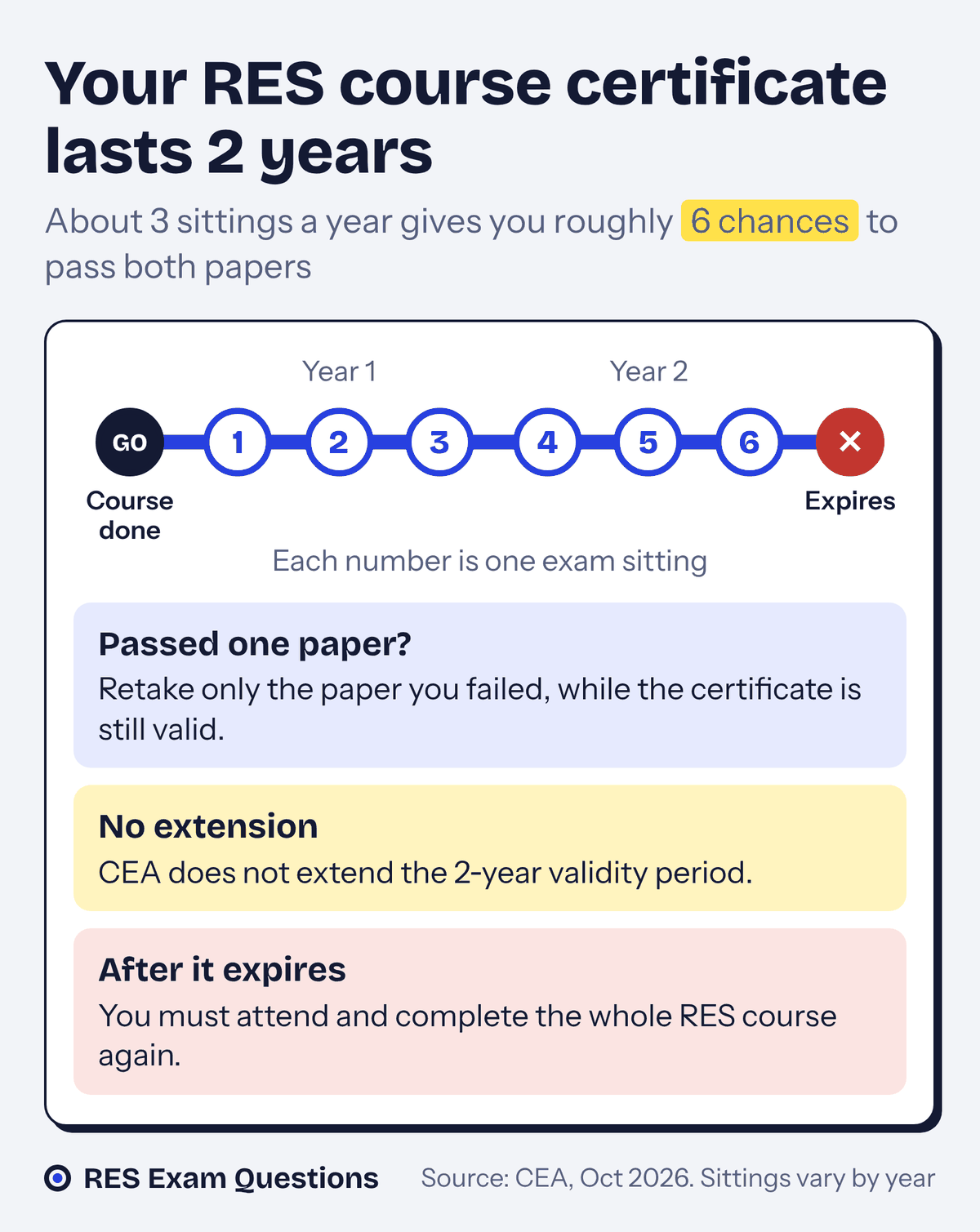
Two years sounds long, but there are only a few exam sittings each year. In 2026 there were three: March, July, and October/November. That gives you roughly six attempts at most. Do not wait a year before your first try.
How to register for the RES course, including SkillsFuture
Registration is done directly with the provider you choose.
- Compare the class schedules and fees on the providers' websites.
- Sign up for an intake and submit your documents, usually your NRIC and education certificates.
- Pay the course fee.
Using SkillsFuture for the RES course
Course fees differ between providers, and so does funding, so compare before you commit. To give you an idea, Ngee Ann Polytechnic lists a full fee of $1,308 including GST, and much lower fees after SkillsFuture funding for eligible Singaporeans and PRs. It also accepts SkillsFuture Credit as payment.
If you want to use your SkillsFuture Credit:
- Ask the provider whether their RES course is SkillsFuture Credit eligible and what the fee is after subsidy. Not every intake or provider has the same funding.
- Check your SkillsFuture Credit balance by logging in to the MySkillsFuture portal with Singpass.
- Follow the provider's instructions to submit your claim through the portal. Do this early, because claims have to be made within a set window around the course start date.
- Pay any balance that your credit does not cover.
NTUC members can also ask about UTAP funding, which some providers accept.
One thing to note: SkillsFuture helps with the course fee. The RES exam fee is separate.
How to register for the RES exam
After you have your certificate, you can register for the exam. NTUC LearningHub runs the exam for CEA. For the October/November 2026 sitting, registration worked in two stages:
- Indicate your interest. This is done online on GovEntry, and you log in with Singpass. The window is short and places are given on a first-come-first-served basis. Only one submission per NRIC or FIN is allowed.
- Register and pay. If you get a place, NTUC LearningHub emails you. You then complete your registration and payment on its website.
Because places are first-come-first-served, mark the date and be ready when the window opens. Check the CEA exam page for the next dates.
RES exam dates for 2026 and 2027
In 2026 the exam was held in March, July, and on 31 October and 1 November. Paper 1 is on Saturday and Paper 2 on Sunday, both from 9.30am to 12pm. At the time of writing, CEA has not announced the 2027 dates.
RES exam fees
- Both papers in one sitting: $512.30
- One paper only: $283.40. This applies only if you have already passed the other paper.
If you do not turn up, you are marked absent and treated as having failed. Deferment is allowed only for a few reasons, such as hospitalisation on the exam day.
RES exam format and passing mark
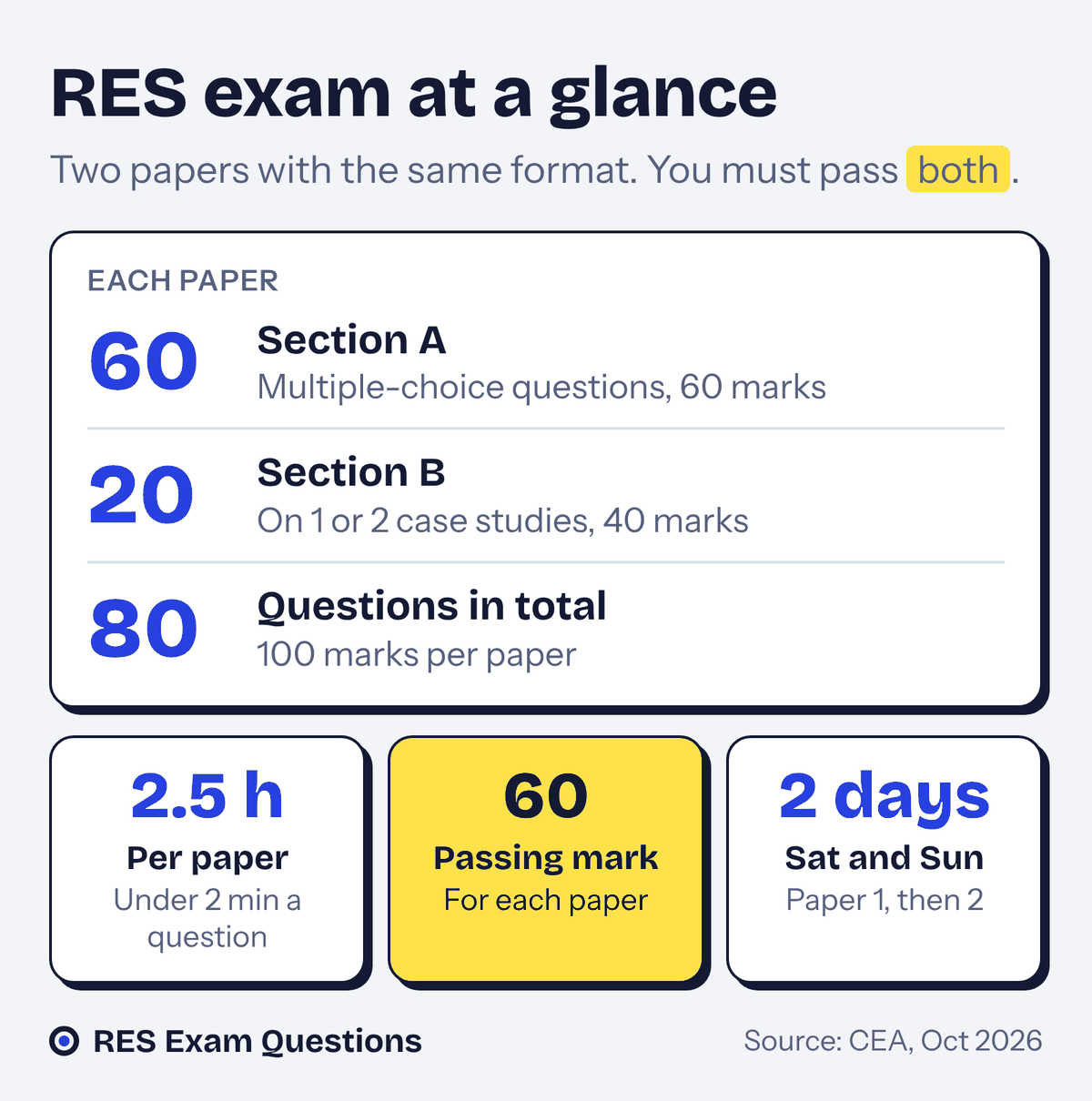
There are two papers. Each paper has the same structure:
- Section A: 60 multiple-choice questions, worth 60 marks
- Section B: 20 multiple-choice questions based on one or two case studies, worth 40 marks
- Time: 2.5 hours per paper
The passing mark is 60 for each paper. You must pass both.
If you pass one paper and fail the other, you only need to retake the failed paper, as long as your course certificate is still valid.
The syllabus changes from 1 January 2027
CEA has revised the RES exam syllabus, and the new syllabus applies to exams from 1 January 2027. If you are starting your course now, you will most likely sit under the new syllabus. Make sure your notes and practice questions are written for it.
RES exam results and registering as an agent
NTUC LearningHub emails your Statement of Results within four to six weeks after the exam.
Once you pass both papers, you have two years to apply for registration through a licensed estate agency. Choose your agency with care. The training, mentorship and support you get in your first year will shape how fast you close your first deal.
How to prepare for the RES exam
The exam is all multiple-choice, but do not let that fool you. Many questions give you four answers that all look right. You need to know the exact rule to pick the correct one.
What works for most candidates:
- Start revision while the course is running. Do not wait for the course to end.
- Practise RES exam questions by topic. After each lesson, attempt questions on that topic to find out what you did not understand.
- Read the explanation for every wrong answer. Knowing why you got it wrong is where the marks come from.
- Do full timed papers before the exam. Eighty questions in 2.5 hours gives you less than two minutes per question. Train for the pace.
- Do not neglect case studies. Section B carries 40 of the 100 marks.
You can try our free 10-question sample test to see where you stand. The full bank of RES exam questions on this site is written for the 2027 syllabus, with an explanation for every answer. More study guides are on our RES exam guides page.
Frequently asked questions
Is the RES exam difficult?
It is manageable if you prepare properly, but many people underestimate it. The content is wide and the questions test fine details. Plan for steady revision over several weeks, not a last-minute rush.
How many times a year is the RES exam held?
There were three sittings in 2026: March, July, and October/November. Check CEA's website for the current schedule.
Can I take the RES exam without attending the course?
No. You need a valid Certificate of RES Course Completion to register for the exam.
How long is the RES course certificate valid?
Two years from the date of the certificate, with no extension.
Can I use SkillsFuture Credit for the RES exam fee?
SkillsFuture funding applies to the course. The exam fee is paid separately to NTUC LearningHub.
Can a PR become a property agent in Singapore?
Yes. Singapore Permanent Residents can register, subject to CEA's requirements.